
Bringing up something new in your intimate life does not have to feel risky, awkward, or loaded. The short answer is this: talk about novelty as an invitation, not a request for performance; choose a calm moment outside intimacy; make it easy for your partner to say yes, no, or not now; and keep the conversation anchored in connection rather than pressure.
New to Whyzper? Discover how our app helps couples deepen their connection. Learn more about Whyzper!
Many people are not afraid of the idea itself. They are afraid of what the conversation might mean. Will this sound like criticism? Will my partner think they are not enough? Will I hurt them? Will I be rejected? Those fears are common in long-term relationships and in newer ones too.
The good news is that the way you bring up a new desire often matters more than the desire itself. When the conversation feels emotionally safe, respectful, and low-pressure, couples are much more likely to stay open, curious, and connected.
Why this conversation feels so sensitive
Talking about sexual intimacy can stir up old relationship patterns very quickly. A simple sentence like “I want to try something new” can accidentally land as “what we have now is not enough” or “you are disappointing me,” even when that is not what you mean.
- Desire and attraction
- Emotional safety
- Fear of rejection
- Body confidence
- Past misunderstandings
- Relationship communication habits
That is because intimate conversations often touch multiple layers at once:
If one partner already worries about not being enough, novelty can sound like a verdict instead of a shared exploration. If the relationship has a pattern of defensiveness, shutdown, or avoidance, even gentle suggestions can feel bigger than they are.
What makes a partner feel pressured
That does not mean you should stay silent. It means the conversation needs care.
- The topic is raised in the middle of intimacy, when they feel exposed
- The suggestion sounds like a complaint or comparison
- There is no easy path to decline
- The conversation carries disappointment, sulking, or withdrawal
- One person keeps revisiting the topic before trust has been rebuilt
- The idea is framed as proof of love, openness, or commitment
Pressure is not only about demanding words. It is also about timing, tone, repetition, and emotional consequences. A partner may feel pressured when:
A useful rule: if your partner feels responsible for managing your reaction, the conversation may no longer feel fully free.
What to do before you bring it up
1. Check your intention
Consent thrives where emotional safety is real, not assumed.
- “I want us to feel closer.”
- “I want to share more of my inner world with you.”
- “I am curious about what could feel good for us.”
Ask yourself: Why do I want to share this? The healthiest answers usually sound like:
- “I need to fix our intimacy immediately.”
- “I need them to prove they are open-minded.”
- “I want this conversation to end with a yes.”
Less helpful starting points sound like:
2. Regulate before you speak
If your real goal is to secure agreement, your partner will usually feel that pressure, even if your words sound soft.
If you feel highly anxious, frustrated, or deprived, try not to start the conversation in that emotional peak. You do not need to be perfectly calm, but you do need enough steadiness to hear a response that may not be immediate or enthusiastic.
3. Get specific with yourself first
A grounded conversation sounds more like, “I want to share something tenderly,” than “We need to talk about what is missing.”
Sometimes people bring up “something new” in vague terms, and the vagueness itself creates anxiety. You do not need a script for the whole future, but it helps to know what you actually mean. Is it more playfulness? More emotional build-up? A different mood? A new kind of closeness? A fantasy you want to discuss, not necessarily act on?
The best time to talk about trying something new intimately
Specificity reduces fear because it makes the unknown smaller.
The best timing is usually outside the bedroom and outside a moment of active conflict. Choose a time when neither of you is rushed, tired, or already emotionally flooded.
- During a walk
- On a quiet evening when you already feel connected
- During a general relationship check-in
- After a warm moment, but not in the middle of intimacy
Good moments often look like:
- Right after rejection or disappointment
- In bed when one person feels cornered
- During an argument
- By text if the topic is emotionally loaded
Less ideal moments include:
How to start the conversation gently
Timing will not solve everything, but bad timing can make even loving communication feel unsafe.
A good opening does three things: it reassures, it invites, and it removes pressure.
- Affirm the relationship
- Name your curiosity
- Make consent and honesty easy
Try a structure like this:
- “I really love being close with you, and there’s something I’ve been curious to talk about. No pressure at all, but would you be open to a gentle conversation?”
- “This is not about you doing anything wrong. I just want to share a thought about our intimate life and hear how it feels for you.”
- “I’ve been noticing some curiosity in myself, and I’d rather share it with you honestly than keep it in my head. You don’t need to respond right away.”
Examples:
Exact language that protects emotional safety
Say this instead of making it a verdict
These openings matter because they lower the chance that your partner hears criticism before they hear care.
Try “I” language that shares experience rather than assigning blame.
- “I’ve been feeling curious about…”
- “I’d love to explore what feels exciting for us these days.”
- “I’m not attached to any specific outcome. I just want to talk openly.”
- “If this doesn’t resonate, that’s okay. I still want to understand your experience.”
- “You can say no, maybe, or not now.”
Helpful phrases:
- “We never do anything different.”
- “Other couples are more adventurous.”
- “If you loved me, you’d at least try.”
- “You always shut things down.”
Less helpful phrases:
How to talk about novelty without implying your partner is not enough
One sentence can keep the whole conversation safe: “I care more about us feeling okay talking about this than about any particular answer.”
This is one of the biggest fears in relationship communication around sexual desire: that wanting something new means the current connection is inadequate. In reality, novelty and appreciation can coexist.
- “This is not coming from dissatisfaction. It’s coming from wanting to keep growing together.”
- “I’m not asking because you’re lacking anything. I’m sharing because I trust you.”
- “What we have matters to me. I’m interested in adding to it, not replacing it.”
You can say that directly:
If your partner gets defensive or shuts down
That kind of framing is especially helpful in long-term relationships, where routine can quietly form and both partners may want relationship improvement without wanting criticism.
Even with excellent wording, your partner may still tense up. That does not automatically mean the conversation failed. It may simply mean the topic touched vulnerability.
- “I can feel this might be landing as a lot. We can pause.”
- “I’m not asking you to decide anything right now.”
- “What did you hear me say? I want to make sure I’m being clear and kind.”
- “Would it help if I explained what this means to me emotionally, not just practically?”
If that happens, slow down. Do not push harder. Try:
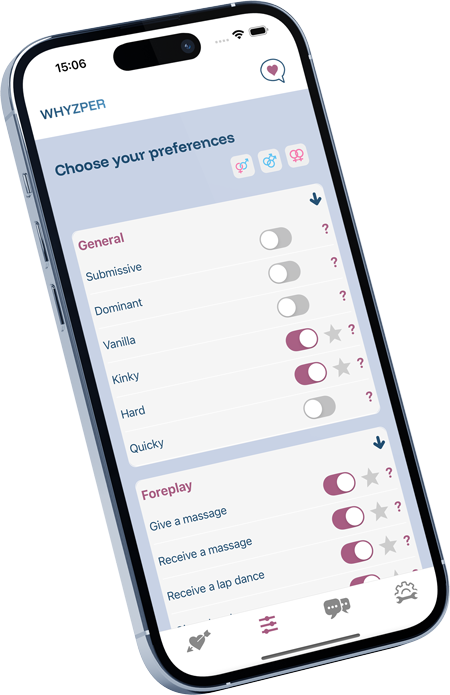
Ready to explore your desires together?
Whyzper lets you share your sexual desires playfully and without pressure – privately and only when both partners agree.
Download Whyzper for freeOften, defensiveness softens when people feel understood rather than managed.
If they say no, respect matters more than persuasion. A respectful response might be: “Thank you for being honest. I’d still love to understand what feels uncomfortable or off about it, if you want to share.”
The difference between invitation and pressure
This keeps the door open to connection, even when the answer is not what you hoped.
Invitation sounds like:
- “Would you be open to talking about this?”
- “How does this land for you?”
- “There is no rush.”
- “Your honest answer matters.”
Pressure sounds like:
- “Come on, just think about it.”
- “Why are you making this such a big deal?”
- “You never want to try anything.”
- “I guess I just can’t talk to you about these things.”
What if you are the more curious partner in the relationship?
Here is a simple comparison many couples find useful:
The key distinction is freedom. An invitation preserves your partner’s freedom. Pressure tries to shape their answer.
Different levels of curiosity, sexual desire, or comfort with change are common relationship dynamics. It does not mean one person is evolved and the other is repressed. It usually means you have different pacing, histories, and emotional associations.
- Starting smaller than you want to
- Separating fantasy from action
- Giving your partner time to reflect
- Welcoming mixed feelings without taking them personally
If you are the partner bringing up novelty, your job is not to drag the other person into your pace. It is to create enough safety that real honesty becomes possible.
What if you are the hesitant partner?
That may mean:
Real intimacy is not built by winning the conversation. It is built by making truth safer than performance.
- “I’m glad you told me. I need a little time to process.”
- “I’m open to understanding more, but I’m not ready to answer yet.”
- “Part of me feels curious, and part of me feels nervous.”
- “Can we talk about what this means emotionally before we talk about specifics?”
If your partner brings up something new and you feel flooded, you are allowed to slow things down without shaming them for asking.
A simple framework couples can use
You might say:
1. Reassure
This kind of response supports emotional intimacy and consent at the same time.
If you want a practical structure, try this four-step conversation:
2. Reveal
Start with care and appreciation.
“I love our connection, and I want to talk about something tenderly.”
3. Release pressure
Name the curiosity clearly and calmly.
“I’ve been thinking about whether we might enjoy exploring something a little different in our intimate life.”
4. Receive
Make room for any response.
“You do not need to have an answer right now, and I don’t want you to feel pushed.”
Listen without correcting, debating, or persuading.
How Whyzper fits into these conversations
“I want to hear what comes up for you, even if it’s uncertainty.”
This framework works because it supports trust, confidence, and closeness instead of turning vulnerability into a negotiation.
For some couples, the hardest part is not the desire itself. It is finding a way into the conversation without awkwardness. That is where a discreet, emotionally intelligent tool can help. Whyzper is designed to support couples in expressing intimacy, desire, and emotions in a way that feels private, respectful, and low-pressure.
Common myths about bringing up new intimate ideas
Myth: If we are truly compatible, this should be easy.
Used well, a tool like Whyzper does not replace real communication. It softens the entry point. It can help partners share preferences, curiosities, and emotional signals with more ease, especially when direct wording feels vulnerable at first.
Myth: If my partner loves me, they should automatically be open.
The goal is never to bypass consent or force intensity. The goal is to make honest connection feel safer.
Myth: A hesitant response means rejection.
Reality: Even strong couples can struggle with relationship topics involving desire, boundaries, and change.
Myth: It is better to avoid the topic than risk awkwardness.
Reality: Love does not erase personal limits, pacing, or emotional associations.
FAQ: Talking about trying something new intimately
How do I bring up something new without making it awkward?
Reality: Sometimes it means “I need more safety, clarity, or time.”
What if my partner says no?
Reality: Silence often creates more distance than a gentle, respectful conversation does.
Should I bring it up during intimacy if the moment feels right?
Choose a calm moment outside intimacy, lead with reassurance, and frame it as curiosity rather than a demand. Keep your first conversation simple and low-stakes.
What if I am afraid of being rejected for even asking?
Respect the no without sulking or persuading. If they are open to it, ask what feels uncomfortable so you can understand their experience better.
Final thoughts
Usually no, especially if the topic is emotionally loaded. People are more likely to feel free and safe when the conversation happens outside the moment.
That fear is very common. Start small, be honest that the topic feels vulnerable, and focus on sharing your inner world rather than trying to secure a specific outcome.
If you want to talk about trying something new intimately without pressuring your partner, remember this: the real skill is not perfect wording. It is creating a conversation where both people stay fully human.